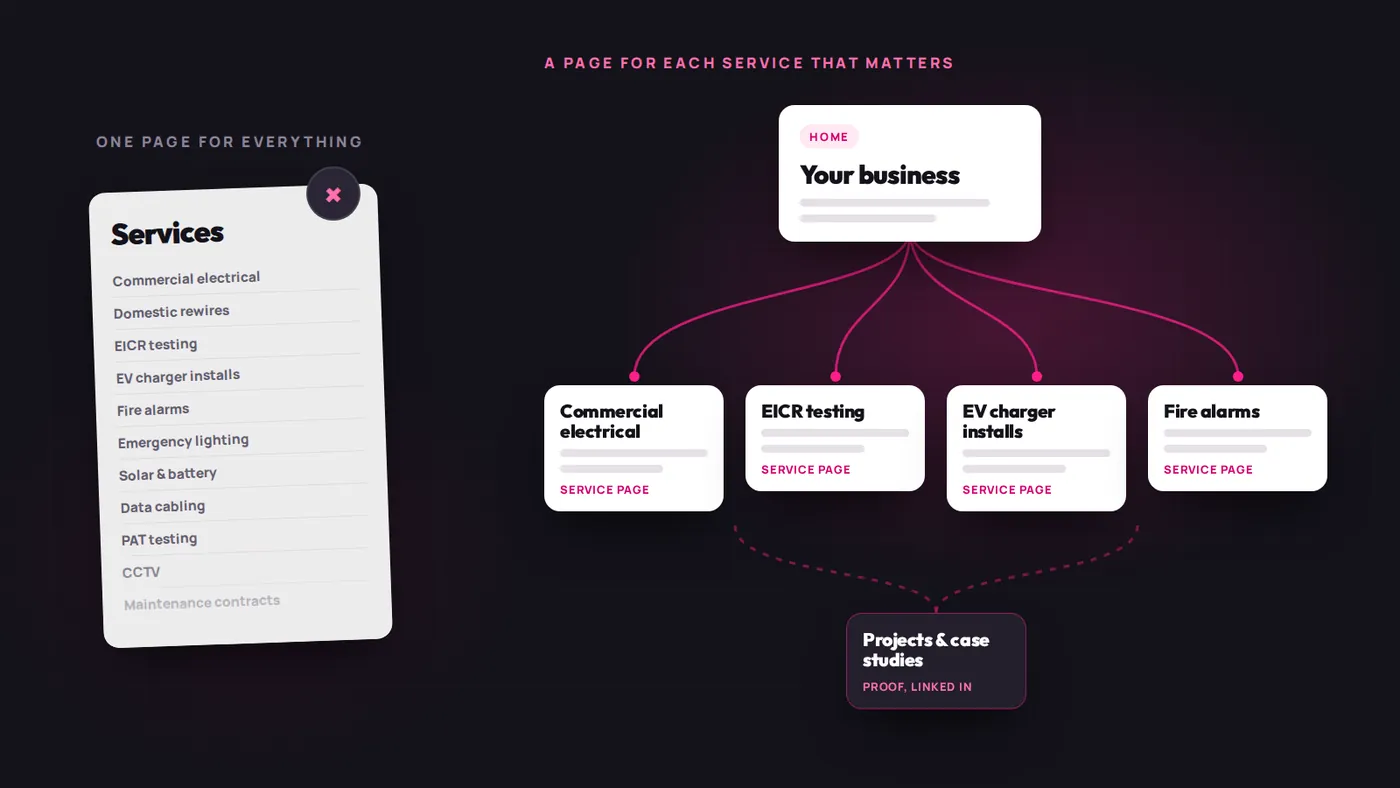
No — but important services often should. A separate page for every tiny variation is not good SEO, and neither is one enormous page listing everything you do. The right structure sits between the two.
Should every service have its own page for SEO?
Only when the page can genuinely help someone. A page per keyword variation spreads thin content across the site. One giant Services page buries every subject. The answer is a page for each service people actually search for and buy separately — no more, no fewer.
How do you decide which services need a page?
Start with search intent, not your internal service list. Businesses organise services the way they operate; customers don’t necessarily search that way. Before creating a page, ask:
- Do people search for this service on its own?
- Is it a genuinely different need or buying decision?
- Can we say something useful and specific about it?
- Does it matter commercially to the business?
When does a service deserve its own page?
When it has distinct search demand, a different buying intent, enough unique information to be useful, genuine examples or projects, and real commercial importance.
For an electrical contractor, commercial electrical work, EICRs and EV charging may each warrant their own page — see how we approach websites for electrical contractors. For a flooring company, epoxy flooring and LVT can be completely different searches and customers — as on our flooring company websites.
Here’s what that structure looks like on sites we have built, as published in their case studies:
When shouldn’t you create another page?
When the only difference is the wording. “Construction web design”, “construction website design” and “website design for construction companies” don’t need three pages. If the intent is the same, one strong page — like our construction web design page — can target the topic naturally.
- Same intent, different wording
- Copy with the nouns swapped
- The site competing with itself
- Nothing new to say on any of them
- Covers the topic properly
- Real projects and proof
- Earns the links and the rankings
- Easier to keep up to date
What should a good service page include?
It depends on the service, but a useful page usually covers:
- Who the service is for
- What is involved, the options and the applications
- Genuine projects and photographs
- The common questions customers actually ask
- Relevant locations, where you genuinely work
- A clear next step
Don’t force every page into one template with the nouns swapped. Google’s guidance on helpful, people-first content is the right test.
How should services link to projects and sectors?
A service doesn’t exist in isolation. A construction company might have a Commercial Refurbishment service page, an Education sector page and a completed school refurbishment project. Linking those naturally lets a customer move through the evidence, and makes the relationships between subjects clear to search engines.
The service page explains what you do. The project proves you have done it.
Do you need location pages as well?
A service page and a location page answer different questions. The service page explains what you do; a worthwhile location page shows why you are relevant in a particular area. That doesn’t justify cloning a service page fifty times and changing the town name. We go into this properly in why one page cannot rank for ten towns.
A simple test before creating any new SEO page
- Would we still create this page if Google didn’t exist?
- Does it help a potential customer understand or choose this service?
- Can we say something genuinely useful and specific?
- Do we have evidence, experience or examples to back it up?
- Is its purpose meaningfully different from a page we already have?
If most of the answers are no, don’t create it.
How we structure sector websites
For businesses with several valuable services, we usually build a connected structure: core services, sectors, locations where they are justified, projects and case studies, and supporting advice. Each important subject gets enough room, without turning the site into hundreds of thin landing pages — the same thinking behind our SEO for construction companies and SEO work.
Need help structuring your website for search?
If your site has one Services page trying to rank for everything — or a hundred pages that all say almost the same thing — we can simplify it around the searches that matter.
Talk to Whiteski →Sources. Creating helpful, reliable, people-first content — Google Search Central · AI features and your website — Google Search Central